
Do Not Compete on Scale, Compete on Meaning
Do Not Compete on Scale, Compete on Meaning
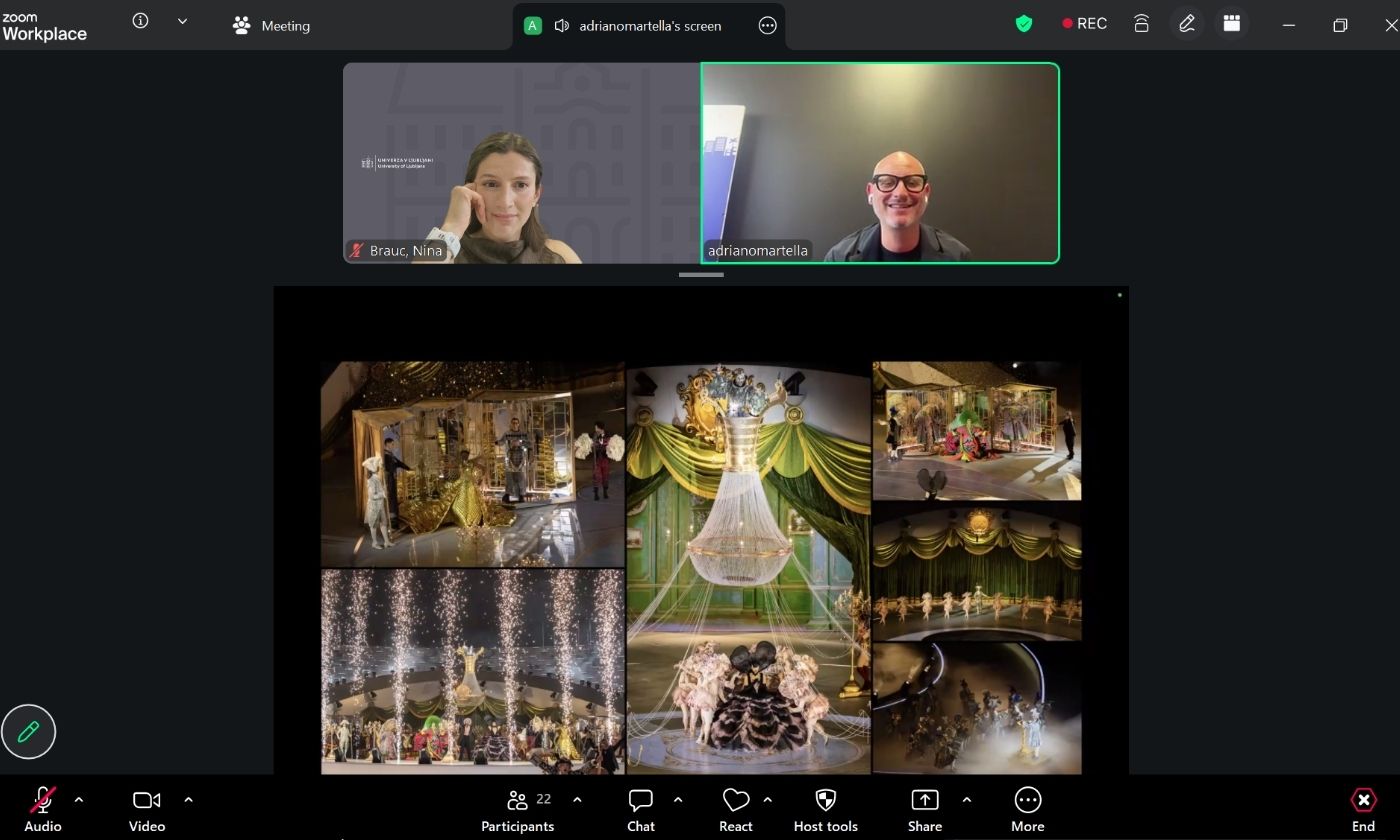
On Tuesday, 9 June, the alumni community welcomed Adriano Martella, Creative Director of the Milano Cortina 2026 Olympic Winter Games Closing Ceremony. In an online presentation, he took us behind the scenes of an event many of us had watched on screen, revealing that behind the magnificent images lay far more than spectacle alone. Through his storytelling, the ceremony unfolded as a carefully considered narrative about place, people, creativity and legacy.
Many of us watched the Milano Cortina 2026 Olympic Winter Games Closing Ceremony on television, perhaps admiring the grandeur of the scenes, the music, the lights and the movement, without truly stopping to wonder how many decisions, research processes, conversations and acts of creative courage stood behind every frame. This is precisely why the behind-the-scenes perspective felt so valuable. It showed that great moments do not simply happen on their own. They are born from careful listening to the place, to the people and to the story one wants to tell.
Adriano Martella, Creative Director of the ceremony and Head of Creative at Filmmaster, introduced us at the very beginning to a compelling idea: an Olympic Closing Ceremony is usually understood as a celebration, as the athletes’ final gathering and an emotional closing chapter of the Games. His team, however, wanted more. They did not want to create merely a party, but an event that would rethink what a closing ceremony could mean. From this came the thought that shaped the entire presentation: do not compete on scale, compete on meaning.
This guiding idea became all the more important because the venue was not a conventional stadium, but the Arena di Verona, one of the oldest amphitheatres in the world still in use, older than the Colosseum in Rome. It is a space of extraordinary history, beauty and presence, but also one with very real limitations. The Arena does not have unlimited backstage space, room for large scenic elements or the kind of infrastructure one might expect from an event of such scale. That is exactly why one of the key creative decisions was made where many would have seen only a problem.
The limitations became the concept. Since there was not enough space, the team created an underground world beneath the stage. A lift, hidden passageways, sudden entrances and surprising scene changes were not simply technical solutions, but part of the story itself. The Arena was not just the setting, but one of the ceremony’s main protagonists. Its ancient exterior entered into dialogue with contemporary scenography, lighting, digital elements and the language of television. The past was not a backdrop, but a living presence.
From this respect for the space, the role of opera developed naturally. The Arena di Verona is inseparably linked to the operatic tradition, so opera did not appear in the ceremony as a decorative motif, but as a cultural language. Martella emphasised that opera cannot be used superficially. It must first be understood, and only then interpreted. In this, one could sense an important balance between respect for tradition and the desire to bring it closer to a contemporary audience.
The red thread running through the ceremony was beauty, though not as something static or merely decorative. The team spoke of beauty in action. Beauty that moves, changes and connects art, sport, nature and people. Within this framework, water became one of the most powerful symbols. The water cycle connected the mountains, rivers, Venice, the dispersed venues of the Games and the broader message of nature’s fragility and our mutual interdependence. Water was not simply the theme of one scene, but a narrative system that gently, yet clearly, carried a message of sustainability and unity.
At the centre of it all, however, remained people. Martella placed particular emphasis on the idea that athletes are not a protocol element, but the very reason a Closing Ceremony exists. The team therefore wanted to present them as true bearers of the story, not merely as participants in a parade. Just as important were the volunteers, the local community, artists, dancers, costume designers, technicians and all those whom the viewer often does not see, yet without whom the event could never come to life.
The story of local involvement was also deeply moving. The team used costumes, scenic elements and knowledge that already belonged to Verona’s cultural ecosystem. Local creatives, students, dance schools and volunteers all took part in the ceremony. Among them was a volunteer of more than 85 years of age, who had already been involved in the Winter Olympic Games in Cortina in the 1950s and wished to return once more. Stories like this give a large-scale spectacle its human face.
At the end of the presentation, Martella also spoke about legacy. Events of this scale should not disappear the moment the lights go out and the television broadcast ends. Their value lies in the trace they leave in a place, in a community and in memory. As a tribute to this, he also included a small personal detail in the ceremony: a photograph of his grandmother. It was an almost imperceptible moment, yet one that said more than a thousand spotlights: that even the most intimate memories can find their place on the greatest stages. The Milano Cortina 2026 Closing Ceremony showed that a true spectacle does not necessarily have to be the biggest, the loudest or the most expensive. It is most powerful when it knows how to listen to a place, respect history, involve people and turn limitations into meaning that lasts.
Author: Nina Brauc