
Alumni story: David Benedek
Alumni story: David Benedek
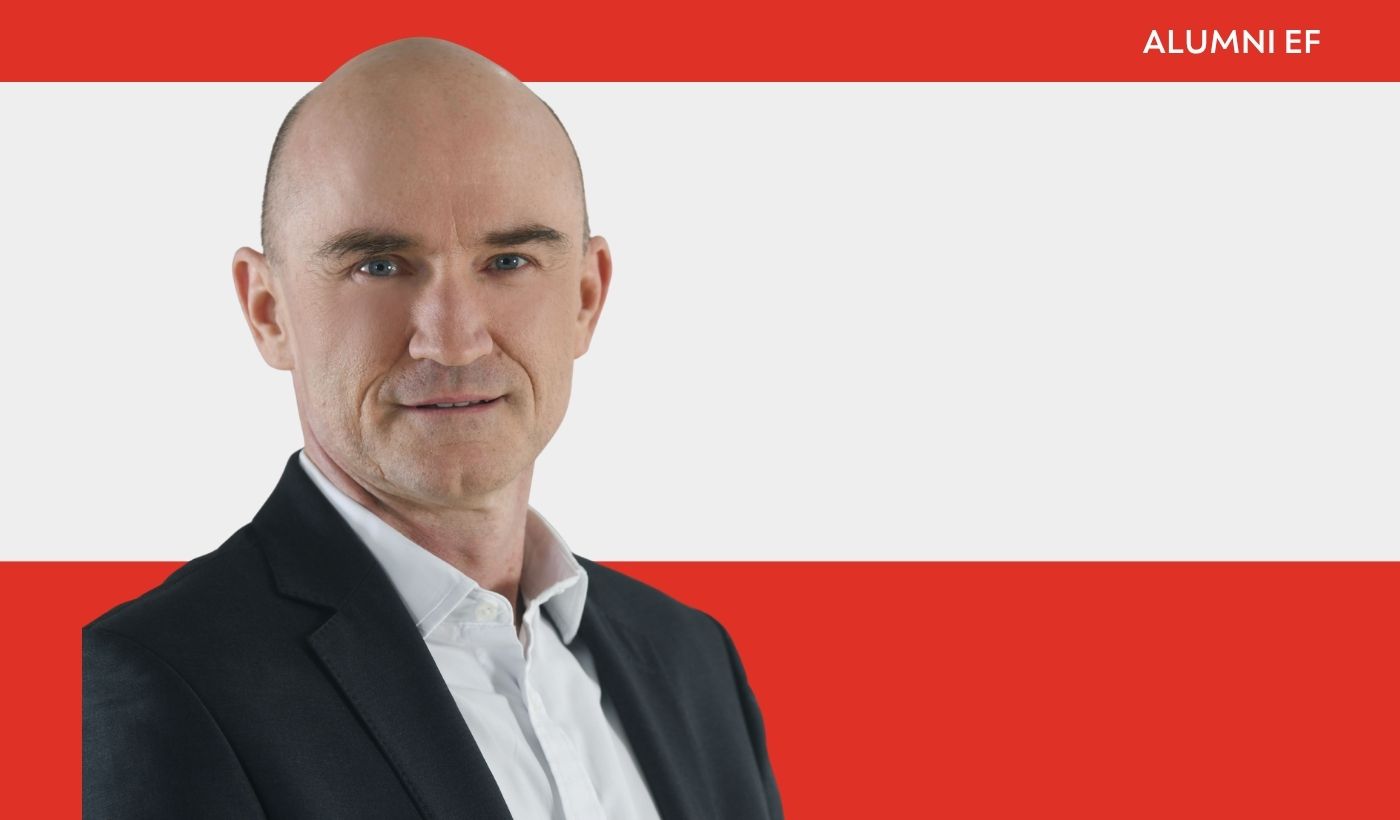
David Benedek has been building his career in the financial industry for almost three decades, from investment banking in New York to senior leadership positions at NLB, Triglav Insurance and, today, Sava Re. As one of our alumni, he emphasises that it was his studies at the School of Economics and Business that first opened the door to the wider world and provided experiences that significantly shaped his professional path. His studies at Indiana University and exchange experience in Singapore introduced him to an international environment, teamwork and a practical approach to solving business challenges. Today, he places the greatest emphasis on people, company culture and thoughtful decision-making. He believes that, in the long run, values, curiosity and a willingness to learn matter most.
The Value of the Right Perspective
Looking back today, how do you remember your student years at the School of Economics and Business, and which moments proved most important on your journey to your current role?
I have very fond memories of my student years. It was a period of discovering new things, both professionally and personally. My studies at the School of Economics and Business gave me a strong theoretical foundation, but above all a great deal of practical knowledge that I was later able to apply in the business world.
The people I met during that time were also a very important part of the experience. I am still in touch with some former classmates and professors today. In particular, I would mention Professor Dušan Mramor, who supervised my thesis and played a key role in helping me secure an exchange opportunity in the United States. Back in the 1990s, studying abroad was far from commonplace, and I remain very grateful to him for his support and encouragement.
The opportunity to study abroad turned out to be one of the key turning points in my life. Even the decision to study economics was an important one, as I had already become interested in finance, banking and numbers while still in secondary school. Continuing my studies abroad opened entirely new perspectives for me. I spent around five years in the United States, combining my studies with my first professional experience, which shaped me both professionally and personally.
When I returned to Slovenia, I continued my career at NLB, where over the course of eleven years I progressed from analyst to member of the management board. I gained experience across a variety of areas, from risk management and financial markets to corporate governance at group level. I later continued building on this experience at Triglav Insurance, Gorenjska Banka and now at Sava Re.
Looking back, I would say that curiosity, openness to new challenges and a willingness to learn were the most important factors throughout my journey.
You first went to Indiana University during your undergraduate studies at the School of Economics and Business, spending a semester there as an exchange student, before later returning to the same university as an MBA student. How did this experience shape you, both professionally and personally, and what ways of thinking or working did you bring back with you?
Studying at Indiana University was truly an excellent experience. At the School of Economics and Business, I gained a very solid theoretical foundation, but during my one-semester exchange in the United States I was introduced for the first time to a different approach to studying and working. That experience convinced me to return to Indiana University in 1998 to pursue an MBA. I wanted to deepen my knowledge in a more practically oriented environment and further immerse myself in finance and investment banking.
The MBA programme was very different from anything I had experienced before. There was a strong emphasis on solving real business cases, teamwork and collaboration with industry. Much of the work was done in groups, and my classmates came from many different countries, so you quickly learned how to work with people who approached problems and ideas from very different perspectives.
I also spent part of my MBA studies in Singapore, which was again a completely different experience. The approach to teaching was somewhat closer to the European or Slovenian model, with a greater emphasis on academic and theoretical knowledge.
What I found particularly interesting was the insight into the Asian business environment. Singapore is closely connected to the wider Asian region and to China, where business approaches are often quite different from those in Europe or the United States. Experiences like this broaden your perspective considerably.
During those five years abroad, I also gained my first serious professional experience alongside my studies. While pursuing my MBA, I visited investment banks in New York and completed internships, which later opened the door to a position at UBS Investment Bank in the United States. It was also during this period that I was first introduced to areas such as behavioural economics and critical thinking, both of which continue to interest me today.
You have served on the management boards of several companies. How would you describe the essence of this role?
People often think that being on a management board is mainly about “giving orders”, but those days are long gone. Today, leadership is fundamentally about working with people.
For me, it is important to surround myself with excellent colleagues who know more than I do in their respective fields. A leader’s role is to support people, guide them, help them develop and create an environment in which they can do their best work. Company culture is also extremely important, as is the ability to connect different stakeholders, employees, business partners, regulators, supervisory boards and the wider public.
At the same time, management boards play an important role in shaping strategy. You need to think long term, recognise changes in the environment and know how to steer an organisation in the right direction.
Which values guide you when making difficult decisions?
For me, good decision-making starts with being well informed. Decision-making is a process. You need to gather as much information as possible, listen to your colleagues, understand the wider context and take time to reflect.
It is also important to challenge yourself and your initial conclusions. Sometimes quick decisions are necessary, but it is always worth asking yourself whether you have looked at the problem from every angle.
And once a decision has been made, you need to stand by it. Perfect information and perfect circumstances almost never exist, so what matters most is being honest with yourself, doing your homework properly and making decisions responsibly.
Your work carries a great deal of responsibility. How do you cope with pressure and consciously maintain a balance between work and your personal life?
At the beginning of your career, it is perfectly normal to work hard and invest enormous amounts of energy into learning. I also worked very intensively during my studies and early professional years.
Over time, however, you realise that without quality free time, long-term professional success is difficult to sustain. It is important to know yourself well and recognise what genuinely gives you energy.
For me, free time is not simply about switching off. I try to dedicate it to things that genuinely matter to me, such as hiking, sport, reading or simply reflecting. I often get my best ideas while walking in the mountains.
In the end, it is all about balance, good organisation and understanding that personal growth matters not only in your professional life, but outside work as well.
Finally, a slightly more personal question. If you could have dinner with one person from any period in time, historical, contemporary or fictional, who would you choose and why? What would you ask them?
It is a question I am often asked, but over the years I have increasingly realised that the world is not black and white, and neither are people. We often admire individuals we do not truly know, while at the same time someone completely unexpected can positively surprise us.
That is why I find it harder today to single out just one person. More than individuals themselves, I value the qualities and values they possess. What I appreciate most in people are broad-mindedness, honesty, humility, reliability and modesty.
I also believe that you can learn something from almost everyone, provided you are open enough to do so. The same applies in the workplace. It is important to recognise people’s strengths and encourage them to develop further. In the end, relationships and the way you work with people are often far more important than titles or positions.