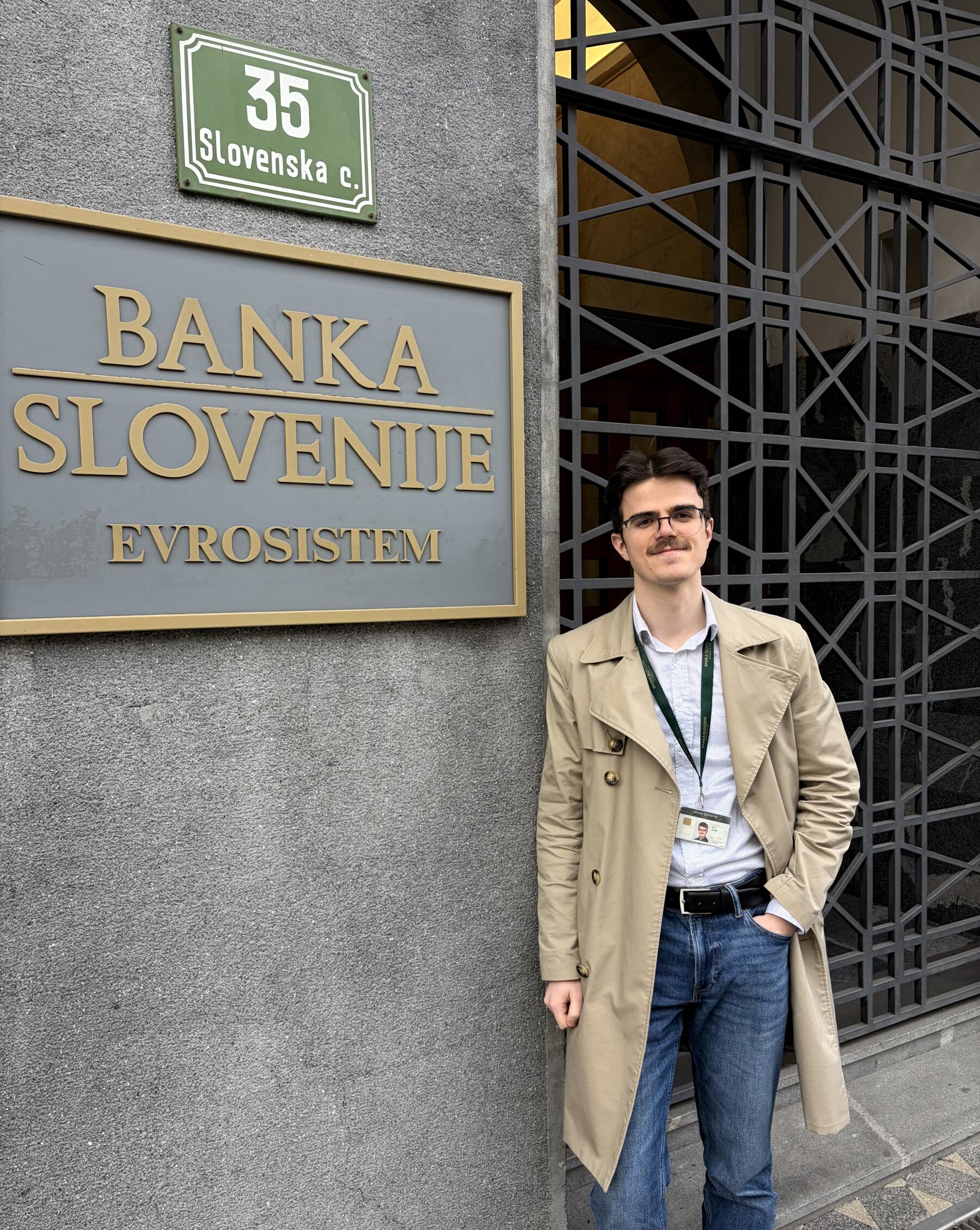
Alumni story: Nejc Perme
Alumni story: Nejc Perme
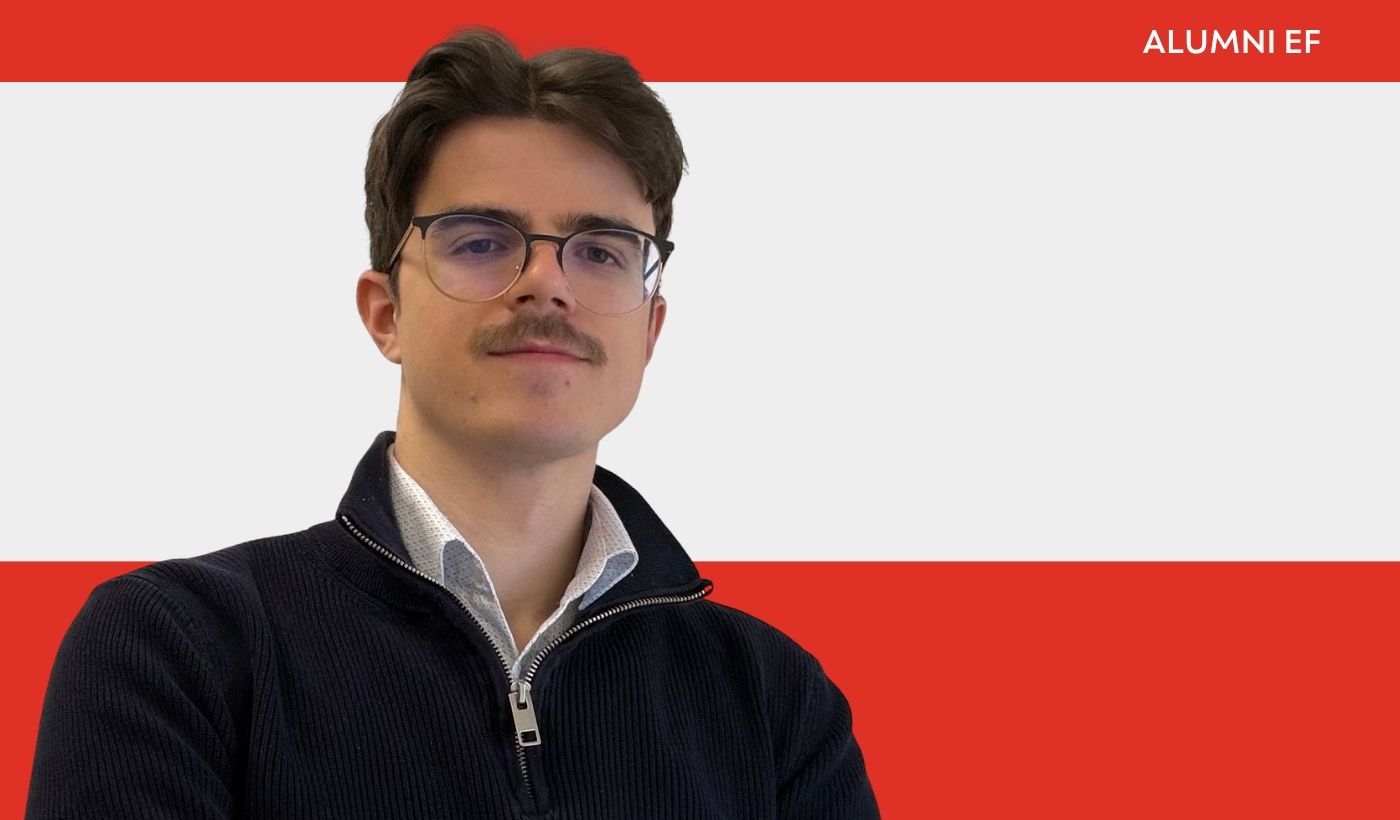
Nejc Perme began his academic journey at the School of Economics and Business without a clear idea of where it would lead him. Today, he works at the Bank of Slovenia, where he focuses on analysing inflation in the euro area. His path was shaped by courses that gradually steered him towards the research side of economics, as well as by the persistence with which he developed his analytical skills. Already during his studies, he stood out for his outstanding academic performance, earning the University of Ljubljana’s award for academic excellence. His story illustrates how curiosity, discipline and an openness to new interests can lead to a well-defined professional direction.
Where Analysis Meets Rhythm
Let’s start at the beginning – what drew you to study at the School of Economics and Business?
If I’m honest, the decision was quite spontaneous. At secondary school, I was interested in a wide range of subjects, from natural sciences to social sciences, so I didn’t have a clear preference. Economics seemed like a good combination of both, as it brings together an understanding of society and the use of quantitative methods.
What also played an important role was the breadth of opportunities the programme offers. I knew I would be able to find my direction along the way, and it turned out to be the right decision.
When did you realise that you were more interested in the research side of economics than the business world?
At first, I was leaning more towards a career in corporate finance, which I also explored through student work. The turning point came in my second year, through courses such as Macroeconomics, Econometrics and International Economics, where I began to discover a more analytical and research-oriented side of economics that I had not been familiar with before.
I was particularly drawn to reading academic papers, understanding them and interpreting their results. That was when I realised that analytical thinking and modelling economic phenomena really suited me, and this gradually shaped my further academic and career decisions.
You completed your undergraduate studies with an outstanding average grade of 9.89 and received an award for academic excellence. What was your approach to studying?
I wouldn’t say there was any particular secret. The key was that I dedicated a great deal of time to my studies and always treated them as a priority.
I was quite focused and didn’t have many commitments outside university, which allowed me to channel most of my energy into studying. It was also important that I had a clear sense of motivation. I knew I wanted to move towards more demanding analytical work and a role in an institution such as the Bank of Slovenia.
At the same time, I made an effort to gain some practical experience, as I believe the combination of knowledge and practice is very important.
Your bachelor’s thesis focused on Okun’s law in Slovenia. What did you find?
I chose to write a bachelor’s thesis even though it is not mandatory in the University degree programme, as I have always enjoyed analysing a specific topic and presenting it in a coherent way.
In my thesis, I examined the existence of Okun’s law in Slovenia, that is, the statistical relationship between economic growth and unemployment. I found that this relationship does exist and is statistically significant, meaning that higher economic growth is associated with lower unemployment.
What I also found interesting was that this relationship changes over time, particularly during periods of crisis. In such periods, time lags become more important, as the effects do not materialise immediately.
At the master’s level, you focused on the transmission of monetary policy in the euro area, also in collaboration with the Bank of Slovenia. How did your research deepen compared to your undergraduate work?
The master’s programme, particularly courses such as Macroeconomics 3 and Econometrics 2 taught by Professor Sašo Polanec and Professor Igor Masten, was much more quantitative and methodologically demanding, but also more rewarding as a result. At times, it felt like I was studying at a completely different institution, as the emphasis on statistical and structural modelling was significantly greater.
My master’s thesis differed from my undergraduate work both in methodological and conceptual complexity, as well as in the level of professional support, which I also received from colleagues at the Bank of Slovenia. I explored which structural factors contribute to differences in the effects of a single monetary policy across euro area member states. A single monetary policy means that the European Central Bank sets common measures, such as interest rates, for all euro area countries, despite their differing economic conditions.
To this end, I analysed factors such as the structure of the economy, particularly the balance between services and manufacturing, as well as characteristics of the financial system, including the share of variable-rate loans and the concentration of the banking sector. Another important factor was the share of liquidity-constrained households.
These factors influence how strongly an economy responds to changes in interest rates. For instance, in economies with a higher share of variable-rate loans, monetary policy measures are transmitted more quickly to households and firms, whereas in more service-oriented economies the transmission tends to be slower. Similarly, households with limited financial resources are more sensitive to changes in borrowing costs, which can amplify the overall impact of monetary policy.
What attracted you to working at the Bank of Slovenia?
I was already interested in the Bank of Slovenia during my studies, mainly because of the connection between macroeconomics and monetary policy. It is a field where theory is directly linked to real-world decisions that affect the economy. I was also drawn to the research aspect of the work, the opportunity to analyse data, prepare analyses and contribute to the shaping of economic policy.
You received a scholarship from the Bank of Slovenia and started your journey there with a one-month internship. What do you remember most from that first experience?
My first experience was very positive, but also quite intense. From the outset, I was given a concrete research task, which later developed into my master’s thesis. This allowed me to quickly immerse myself in monetary policy, while working on a topic that has only recently gained prominence in academic literature. It likely also enabled me to complete my master’s degree more quickly than I otherwise would have.
What surprised me most was how similar the work is to what you do at university, except that it is more applied and directly linked to real decision-making. There is a strong emphasis on writing, analysis and argumentation, which requires a solid understanding of the broader economic context.
What made a particularly strong impression on me was not only the working environment, but also the very entry into the institution. The security system with double doors, where one closes before the other opens, gives you the sense of entering a highly protected and important space, clearly reflecting the institution’s responsibility. This first impression is reinforced by the internal environment, where people are highly motivated, knowledgeable and willing to share their expertise. You quickly feel that you are part of an institution that plays an important role in the economy, which is a strong source of motivation.
What does your work look like today?
I currently focus primarily on analysing inflation in the euro area. This involves monitoring incoming data, preparing analyses and reports, and supporting monetary policy decisions.
A large part of the work involves writing, both internal analyses and contributions to publications. At the same time, there is also a research component, where you can develop your own ideas and contribute to a broader understanding of economic phenomena.
The working environment is very supportive, with colleagues who are highly motivated and willing to share their knowledge, which further contributes to professional development.
How do you see your future?
Looking ahead, I would like to continue deepening my expertise. I do not necessarily see myself in managerial roles, but rather as a specialist contributing high-quality analysis and helping to improve our understanding of economic processes. It is important to me that the work remains intellectually stimulating and that I can continue to develop.
Finally, which topic could you speak about for 40 minutes without any preparation?
Probably inflation, as it is something I work with on a daily basis.
At the same time, I could also speak about music, which has been a passion of mine since a young age. I have been involved in music since primary school, where I played the piano and organ for several years, and today I maintain that connection not only through listening but also by singing in a choir.
Interestingly, I mostly listen to hip hop, even though many might expect me to prefer classical music given my background.
In reality, I believe that analysis and music have more in common than it might seem at first glance. Both require a sense of structure, the ability to recognise patterns, and the skill to turn a large amount of information into something meaningful. It is precisely this combination of analytical thinking and creativity that has accompanied me throughout my journey.